
Taxonomy & naming
The species was described in 1899 by the Belgian-British ichthyologist George Albert Boulenger, in the Transactions of the Zoological Society of London, from syntypes taken at Moliro on the southwestern shore of Lake Tanganyika in what is now the Democratic Republic of the Congo. The combination Xenotilapia sima Boulenger, 1899 has stood ever since and is the valid name recognized today by Eschmeyer's Catalog of Fishes, FishBase and the IUCN. The genus name pairs the Greek xenos, 'strange,' with tilapia (itself from a southern-African word for fish); the epithet sima derives from the Greek for 'snub-nosed,' a fair description of the low, blunt head.
Xenotilapia sits in the tribe Ectodini, the same sand- and intermediate-zone flock that includes Enantiopus, Ectodus, Aulonocranus, Callochromis and Cyathopharynx. The genus itself is large and notoriously heterogeneous — it spans maternal mouthbrooders, biparental mouthbrooders and lek breeders, and experienced keepers routinely note it is overdue for revision. The single most important fact about this species' nomenclature is a long-running case of mistaken identity: X. sima is easily confused with X. boulengeri (Poll, 1942), and Takahashi and Nakaya untangled the two in a 1997 morphometric review (Ichthyological Research 44:335–346), showing that X. sima has more teeth, more anal and pectoral soft rays, a thicker caudal peduncle, larger eyes and a shorter snout. The practical upshot, documented by specialist Tanganyikan sources, is that the fish sold in the hobby as 'X. sima' for years was in fact X. boulengeri; the genuine X. sima was likely first imported only around 2008, and in parts of Europe it has also moved under trade labels such as X. ornatipinnis 'Moliro' or 'Firestream.'
Appearance
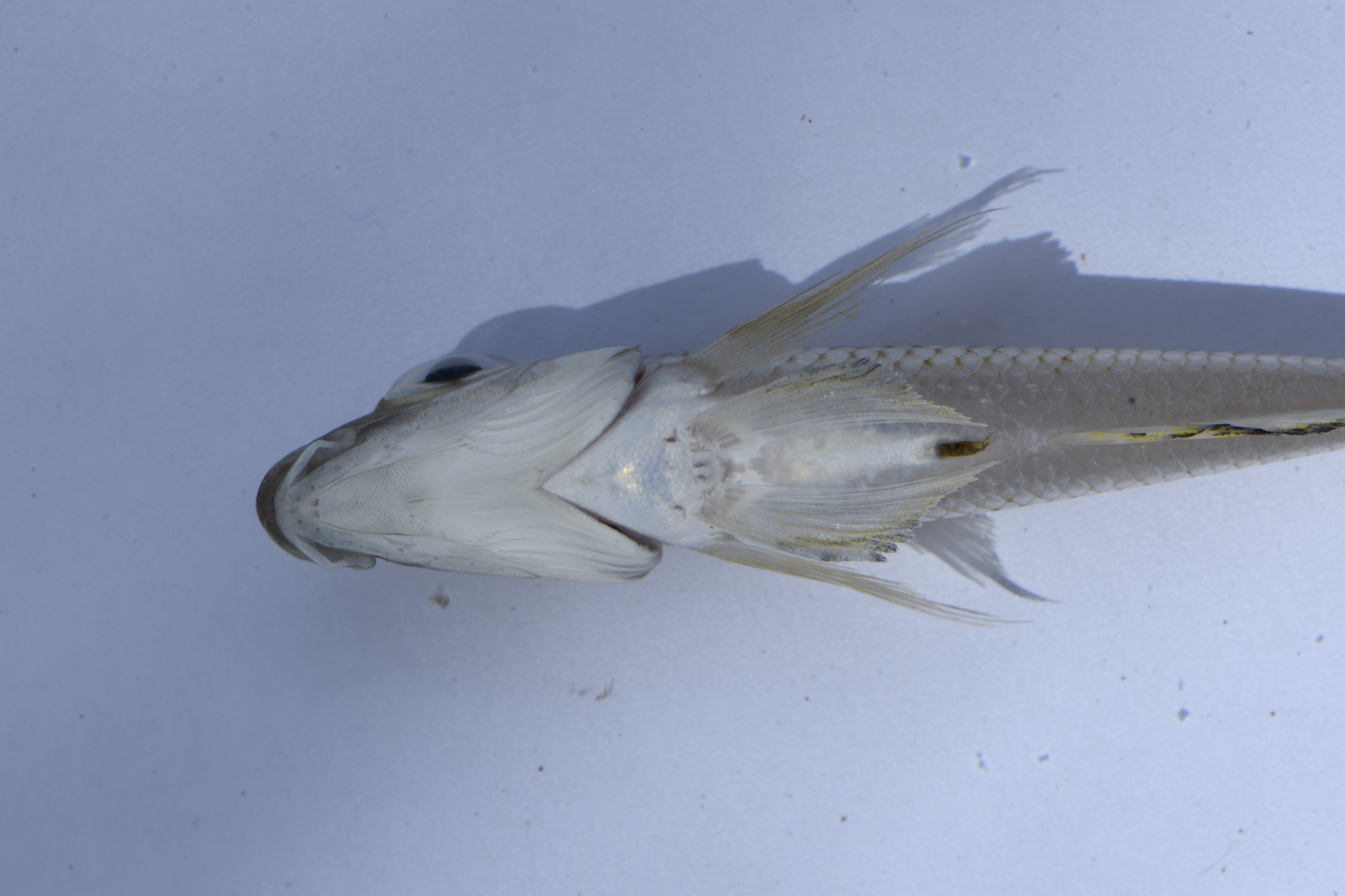
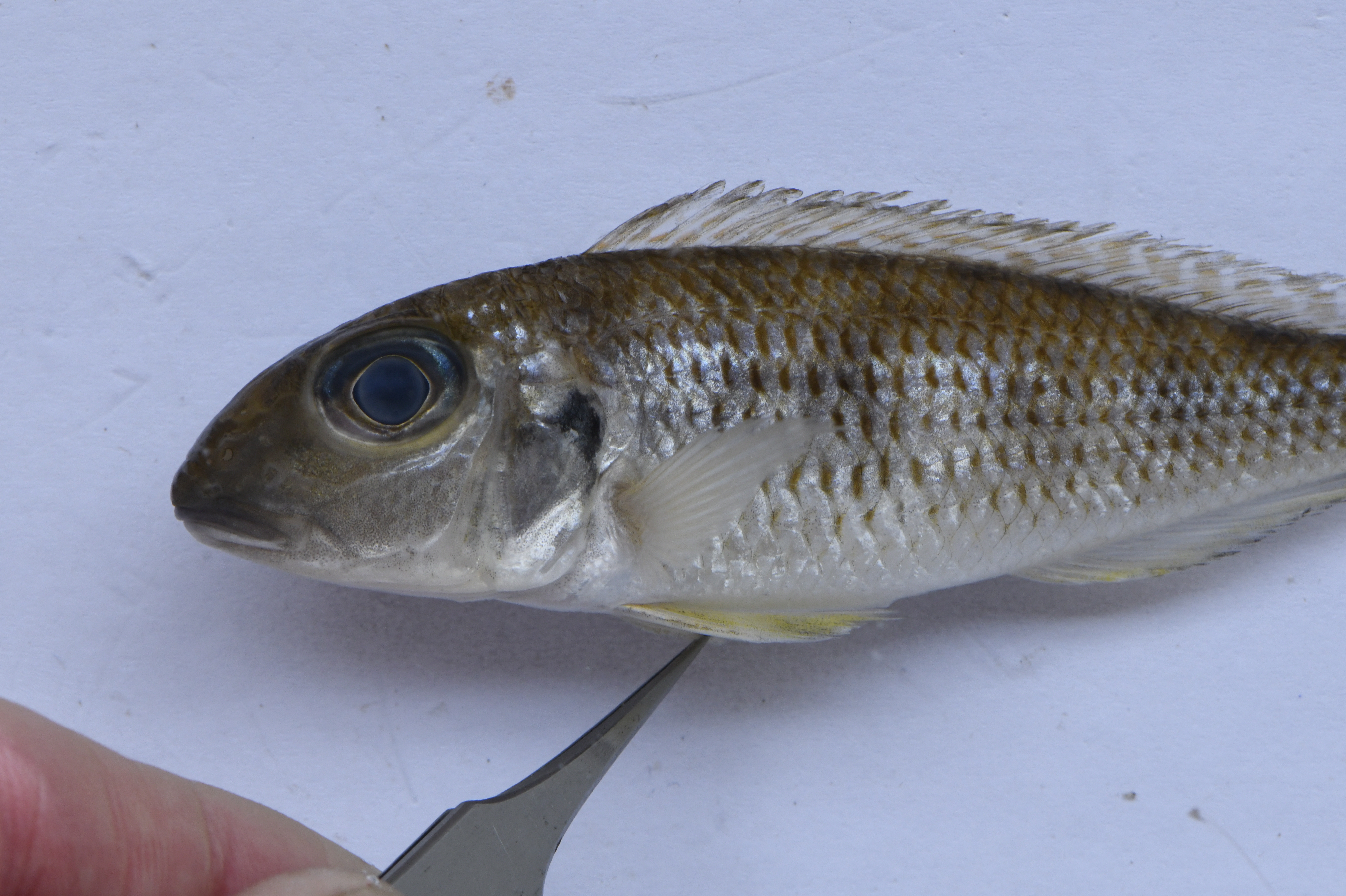
This is a streamlined, sandy-toned cichlid built for life on and against the bottom. The body is silvery to pale fawn, an effective camouflage over the mud and sand it inhabits, and the mouth is set very low on the head — an adaptation that lets the fish feed without lifting its body off the substrate. The eyes are large, which gives the trade name 'big-eyed Xenotilapia' and fits a fish that forages in dim, deeper water.
Maximum size is usually given as about 6.5 in (16.4 cm) total length, the figure carried by FishBase and the IUCN from the CLOFFA checklist; specialist field sources put adult males a touch larger, around 6.7 in (17 cm), with females roughly 0.8 in (2 cm) shorter. Sexual dimorphism is modest but real: males grow larger than same-age females, develop somewhat more pointed dorsal and anal fins, and intensify in color when displaying, often appearing darker. Juveniles grow quickly, reaching 3–4 in (8–10 cm) and sexual maturity within their first year. Because the species was so long conflated with X. boulengeri, much of the older hobby imagery labelled 'sima' shows the wrong fish; the two differ in fin-ray counts and proportions even though they share the same general sand-cichlid silhouette.
Range & habitat
Xenotilapia sima is a lacustrine endemic — it occurs nowhere on Earth but Lake Tanganyika — and within the lake it is widespread, recorded around the shoreline from Burundi, the Democratic Republic of the Congo and Tanzania to the lake's southern reaches, in essentially every stretch of suitable bottom. The IUCN describes it as widely distributed and demersal, favoring sandy and muddy environments and often turning up near river mouths, where fine sediment accumulates.
Depth is where the sources genuinely diverge, and the disagreement is worth stating plainly. Some hobby profiles (Seriously Fish among them) describe it simply as a shallow, open-sand schooler. The more rigorous accounts place it deeper: the IUCN assessment gives a depth band of roughly 115–330 ft (35–100 m), and specialist Tanganyikan references report it most commonly at about 115–165 ft (35–50 m), with records down to 330 ft (100 m). The likeliest reconciliation is that this is fundamentally a fish of the deeper sand and mud floor rather than the surf zone, even if aquarium descriptions, written for tank life, tend to flatten that distinction. Either way the water it lives in is Tanganyika's signature chemistry — hard, alkaline (pH around 8–9) and warm, with the lake's open layers sitting near 75–79 °F (24–26 °C). The fish forms schools over these open bottoms and is extremely well camouflaged against them.
Ecology & diet
Functionally, X. sima is one of Tanganyika's sand-sifters, and it makes its living much as the South American eartheaters (Geophagus) do: it takes a mouthful of sand, sorts the edible fraction inside the mouth and over the gill rakers, expels the clean grains through the gill covers, and swallows what remains. The low-set mouth is the key piece of equipment, letting it work the substrate continuously without rising off the bottom. Gut analyses summarized by specialist sources describe a carnivorous diet built mainly on insect larvae, with smaller amounts of small gastropods and other buried invertebrates; FishBase places the species around trophic level 3.2, squarely in the bottom-feeding carnivore range.
In the community of the sandy and muddy floor, X. sima shares the substrate with other Ectodini and with eartheating relatives that partition the same resource by depth, grain size and foraging style. It is a mid-web fish — a specialized invertebrate predator that is itself prey for the lake's larger piscivores — and its schooling habit over open bottoms is consistent with that exposed, mid-trophic position. Its abundance, noted repeatedly by the IUCN assessors, suggests the sand-sifting niche it occupies is a productive and reliable one around much of the lake.
Behavior & breeding
Socially the species is gregarious and, by cichlid standards, notably peaceful — it lives in schools and is described as generally non-aggressive toward both its own kind and other species when not breeding. That peaceability is the flip side of its temperament in captivity: it is also easily stressed and skittish, prone to bolting at sudden movement or abrupt changes in light.
Breeding is maternal mouthbrooding, and on this point the careful sources agree and correct a common misconception — although the genus Xenotilapia includes several biparental mouthbrooders, X. sima itself is a maternal mouthbrooder, where only the female carries the brood. Before spawning the male excavates a shallow sand scrape as a spawning site, a shallow depression only a few centimeters high and roughly 6–7 in (15–18 cm) across. The female lays into the scrape, the male fertilizes the eggs, and she takes them into her mouth, incubating eggs and larvae for about three weeks. FishBase, citing the developmental work behind the IUCN account, notes that females of about 4.1–4.3 in (10.3–10.9 cm) standard length brood eggs and larvae up to roughly 0.4 in (1.06 cm) before release — the field observations trace back to Kuwamura's 1986 survey of parental care in Tanganyikan cichlids. After the fry become free-swimming the mother continues to guard them for only a few days before abandoning them; specialist sources put a typical brood at around 50–60 fry. The species is not often bred in aquaria, and forum keepers who have worked the genus rate it among the trickier Xenotilapia to spawn rather than a reliable producer.
In the aquarium
The honest framing from experienced Tanganyika keepers is that X. sima is a fish for someone who already knows the genus, not a starting point. It is peaceful and undemanding in temperament but delicate and skittish in practice — a combination that punishes the common beginner setup. On forums, keepers who have run Xenotilapia describe it bluntly as a maternal mouthbrooder of open sandy shallows that is gregarious among its own kind but easily unsettled in captivity, and they steer newcomers toward hardier relatives such as Enantiopus melanogenys instead.
The non-negotiables are a large open floor and a fine sand bed. As an obligate sand-sifter the fish must be able to take mouthfuls of substrate; coarse gravel is genuinely dangerous, as grains can lodge in the throat or abrade the gills, so fine sand is the only sensible choice. Skip dense aquascaping in the center — this is a fish that needs uncluttered space to forage — and keep tankmates calm. Specialist guidance calls for a group of at least eight individuals (more females than males is fine), and for adults a tank no shorter than about 5 ft (150 cm); a roughly 105-gallon (400 L) footprint is a reasonable target, and the smaller 48-in tanks some care sheets cite are really a floor, not an ideal. Water should track the lake: hard, alkaline (pH ~8–9), warm (mid-to-high 70s °F / 23–27 °C), well-oxygenated and scrupulously clean, since this is a fish accustomed to the stable, open water of the lake floor. Suitable tankmates are the more peaceful, non-bottom Tanganyikans — open-water Cyprichromis and Paracyprichromis, or easygoing Neolamprologus — and the species should never be kept with boisterous Mbuna or with other dedicated sand-sifters that compete for the same niche. The mistake that recurs is treating it as a robust community cichlid; it is better understood as a sensitive shoaling specialist that rewards a quiet, sand-floored, single-purpose tank.
Conservation
Xenotilapia sima is assessed by the IUCN Red List as Least Concern, in its most recent assessment (assessed 22 February 2025, published 2025 by Mushagalusa and Fermon), reaffirming a Least Concern listing it has held since 2006. The rating is well founded for the species itself: it is endemic to Lake Tanganyika but distributed lake-wide in suitable habitat, its population is described as very abundant and stable, and it is common enough to appear regularly in the ornamental trade nationally and internationally. The assessment names a single concrete threat — water pollution and the resulting habitat deterioration from sedimentation, driven by soil erosion from agriculture and forestry in the catchment. No part of its range lies in a protected area, and the assessors note that better data on population trends would be valuable.
That 'Least Concern' verdict sits inside a lake under real strain, and the honest summary is that the species is secure today in a habitat whose trajectory is not. Lake Tanganyika is warming: O'Reilly et al. (2003, Nature, doi:10.1038/nature01833) showed that a warming surface has strengthened stratification and weakened the wind-driven mixing that lifts deep nutrients into the sunlit zone, with sediment-core evidence pointing to roughly a 20% drop in primary productivity and an inferred ~30% decline in fish yields over the twentieth century. Cohen et al. (2016, PNAS, doi:10.1073/pnas.1603237113) tied the same warming to a measurable loss of oxygenated benthic habitat — about 38% in their study areas — alongside declines in fish and mollusc populations. These basin-scale forces fall hardest on the open-water clupeid (Stolothrissa, Limnothrissa) and Lates fishery that feeds four nations, and on the deep benthos. For a deeper sand-and-mud fish like X. sima, two threads of that wider story bear most directly: the shrinking of oxygenated bottom habitat that Cohen and colleagues documented, and the catchment-derived sedimentation that the IUCN itself flags for this species — sediment that clouds and smothers exactly the soft floors near river mouths where it feeds. Set against the four-country governance challenge embodied by the Lake Tanganyika Authority, the realistic read is a locally abundant, unthreatened fish whose lake home is being degraded faster than its numbers yet show — secure for now, but no reason for complacency about the water body it depends on.
Sources
- Eschmeyer's Catalog of Fishes — Xenotilapia sima (Boulenger, 1899)
- FishBase — Xenotilapia sima summary
- GBIF — Xenotilapia Boulenger, 1899 (Backbone Taxonomy)
- IUCN Red List — Xenotilapia sima (e.T60720A47211576, Mushagalusa & Fermon 2025)
- Takahashi & Nakaya 1997 — A taxonomic review of Xenotilapia sima and X. boulengeri (Ichthyological Research)
- Koblmüller et al. 2004 — Evolutionary relationships in the sand-dwelling cichlid lineage of Lake Tanganyika (Ectodini phylogeny)
- O'Reilly et al. 2003 — Climate change decreases productivity of Lake Tanganyika (Nature)
- Cohen et al. 2016 — Climate warming reduces fish production and benthic habitat in Lake Tanganyika (PNAS)
- Seriously Fish — Xenotilapia sima (Big-Eyed Xenotilapia)
- tanganyika.si — Xenotilapia sima 'Moliro' (biotope, breeding, identity notes)
- Cichlid Room Companion — Xenotilapia sima profile (Thomas Andersen, subscriber content)
- Cichlid Room Companion — Tribe Ectodini overview (public page)
- AquaInfo — Xenotilapia boulengeri (the species long confused with X. sima)
- Cichlid-Forum — Xenotilapia sima care (keeper discussion, maternal mouthbrooder / delicate) — community/anecdotal
- Cichlid-Forum — Lake Tanganyika Species board (Xenotilapia keeping & breeding threads) — community/anecdotal
- Reddit r/Cichlid — Enantiopus/Xenotilapia keeping experience — community/anecdotal