

Taxonomy & naming
George Albert Boulenger described this fish in 1906 as Paratilapia frontosa, from a single specimen (BMNH 1906.9.8.140) collected at Kigoma, Tanzania, during one of the early Tanganyika expeditions. It was later moved to the genus Cyphotilapia, and Eschmeyer's Catalog of Fishes lists it as valid under that combination. The genus name fuses Greek kyphos, "hump," with Tilapia (itself a Latinization of the Tswana word tlhapi, "fish"); the epithet frontosa points to the prominent forehead. Older synonyms a reader may encounter include Paratilapia frontosa straeleni and Pelmatochromis frontosus.
For most of the twentieth century Cyphotilapia was treated as monotypic — frontosa was the only species in it. That changed in 2003, when Takahashi and Nakaya described Cyphotilapia gibberosa from the southern half of the lake, restricting true C. frontosa to the north. A follow-up study (Takahashi, Ngatunga & Snoeks 2007) examined the six- and seven-banded northern morphs and concluded they are a single species: the seven-banded form is confined to Kigoma on the eastern shore, while the six-banded form occupies the rest of the northern lake. The cleanest way to separate frontosa from gibberosa is the scale count between the upper and lower lateral lines — two rows in frontosa versus three in gibberosa — alongside frontosa's slightly more elongate, less deep body. In the trade nearly everything is sold simply as "frontosa," so famous southern variants like Blue Zaire, Mpimbwe and Moba are, taxonomically, gibberosa even when the label says otherwise.
Appearance
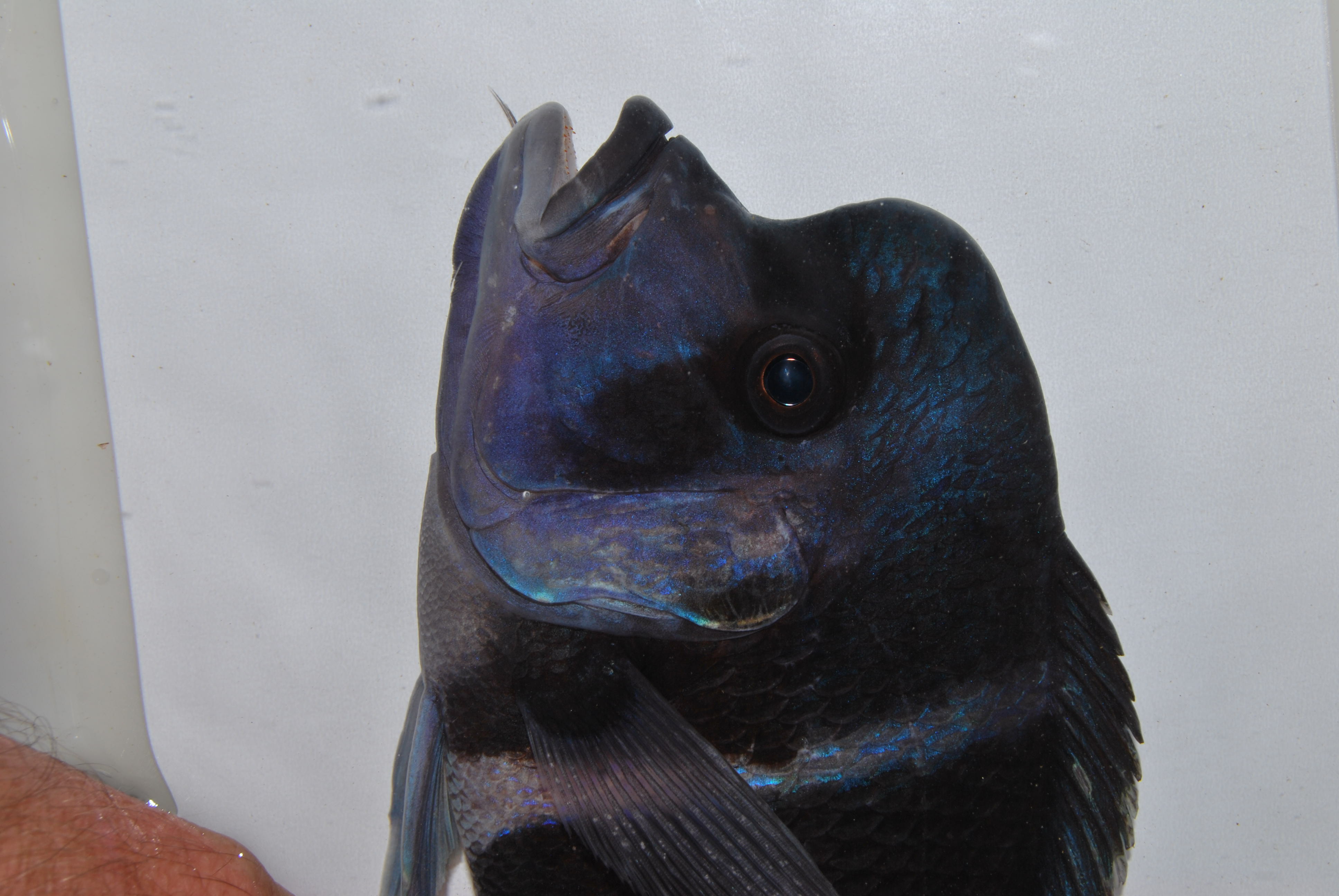
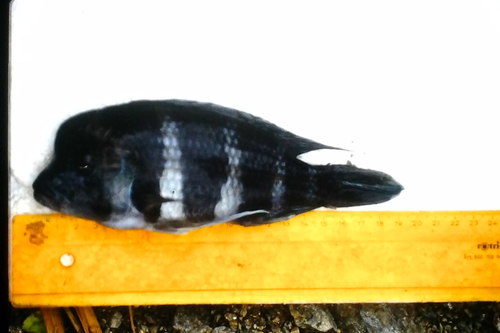
This is one of the largest of Tanganyika's rock-associated cichlids: a tall, laterally compressed body crossed by broad dark vertical bars over a pale-to-steely-blue ground, with blue often washing across the head and fins and, in northern fish, some yellow in the dorsal. The signature feature is the nuchal hump — a fatty bulge on the forehead that enlarges with age and is most exaggerated in dominant males, though females develop a smaller version too, so it is a guide to dominance and maturity rather than a clean sex marker.
Reported sizes vary with how they are measured. FishBase gives a maximum of about 13 in (33 cm) total length; Seriously Fish lists a maximum standard length of roughly 8.7–10 in (22–25.5 cm), which excludes the tail. In practice, well-kept aquarium males commonly exceed 12 in (30 cm), with females noticeably smaller at around 8–11 in (20–28 cm). Males also grow longer and carry more extended dorsal and anal fins. Beyond size, the eye-stripe is the field mark hobbyists lean on: northern frontosa tend to show a thinner, more linear stripe running the length of the face, whereas gibberosa wears a thicker, triangular "Zorro mask" that covers much of the eye. Selectively bred ornamental strains such as the reddish "copperband" also circulate.
Range & habitat
Cyphotilapia frontosa is a Lake Tanganyika endemic, restricted to the northern part of the lake and distributed allopatrically with its southern sister species C. gibberosa — the two do not overlap. Seriously Fish bounds its range roughly between Cape Tembwe on the western coast and Bulu Point on the eastern, spanning shoreline in the Democratic Republic of the Congo, Burundi and Tanzania.
It is a fish of rocky, sediment-influenced slopes that drop into deep water, favoring boulders interspersed with patches of open sand. Exactly how deep it lives is one of the more interesting tensions in the literature. Pierre Brichard reported vast underwater schools — up to about a thousand fish — at 30–40 m (about 100–130 ft), and Seriously Fish describes it as most common between roughly 15 and 70 m. Yet gill-net data summarized in the IUCN assessment show it most abundant much deeper, between 60 and 120 m (about 200–390 ft), with individual size tending to increase with depth. The picture that reconciles these is a fish centered in deep water that ranges shallower to feed, with the largest animals holding deepest. Its native water is hard and alkaline — pH around 8 or above — and warm but thermally stable, a consequence of the sheer size of the lake buffering it against weather.
Ecology & diet
Frontosa is best described as a generalized predator rather than a specialist. FishBase and the IUCN both characterize it as feeding on fish and macro-invertebrates, with mollusc shell fragments turning up in gut contents; algae and detritus are also ingested, probably incidentally while the fish mouths sand and rock. Its trophic level is modest for a predator (FishBase estimates about 2.9), consistent with a mixed diet rather than pure piscivory.
The most-cited piece of its natural history is a hunting strategy keepers love to repeat: at dawn frontosa move up the slope to prey on the open-water "sardine" cichlids of the genus Cyprichromis, and on the lake's clupeid sardines (Limnothrissa miodon, Stolothrissa tanganicae) and small fishes, picking off animals that are themselves resting or poorly oriented in dim light. The fish's large mouth and unhurried, deliberate approach suit an ambush predator that overtakes slower or sleeping prey rather than running them down. Between such feeds it sifts the substrate for invertebrates. As a large, comparatively long-lived predator gathering in big aggregations, it occupies an upper rung of the rocky-zone community.
Behavior & breeding
Socially, frontosa is gregarious but not strongly territorial in the way many rock cichlids are. Rather than each male defending a patch, the fish form colonies organized by a dominance hierarchy: one or more alpha males claim the best shelters, with subordinate males and a parallel female hierarchy filling in around them. Aggression is real but diffuse — chasing flares around the dominant fish and intensifies at breeding — which is why both the literature and experienced keepers stress group size and space as the main tools for keeping the peace.
Reproduction is maternal mouthbrooding, and it is unusually drawn out. Females produce small clutches of large eggs — commonly cited as 10–50 depending on the female's size — take them up immediately after fertilization, and hold the developing young for an exceptionally long time, on the order of 35–50 days or more. The remarkable part is documented science, not folklore: Yanagisawa and Ochi (1991), working in the lake, showed that brooding females keep feeding while holding, with about a quarter of the gut fullness of non-brooding adults, and that the larvae themselves feed on particles inside the mother's mouth — "buccal feeding" — while still carrying large yolk reserves. Kuwamura (1986) likewise recorded females brooding young up to about 1.66 cm. This extended in-mouth provisioning is read as an adaptation to a habitat with few safe crevices: the fry are not released until they can fend for themselves.
In the aquarium
Frontosa is a rewarding fish but emphatically not a beginner's or a small-tank fish, and honest sources converge on that. Adults are big and the colony is the point, so footprint matters more than gallons: a 6 ft (180 cm) tank is the widely cited practical minimum for a group, with serious keepers running 7–8 ft (210–240 cm) tanks, and Seriously Fish recommends dimensions around 240 x 60 x 60 cm. A typical stocking is one or two males with five or six females; keeping more females than males, and providing enough large caves for the dominant fish plus smaller refuges for holding females, spreads aggression and reduces bullying.
Water should mirror the lake: hard, alkaline (pH roughly 8.0–9.0), warm and stable, with frontosa being notably intolerant of deteriorating water quality — they should never go into an immature tank, and weekly water changes are standard advice. As deep-water fish they prefer subdued lighting and dark refuges, and can be skittish under sudden brightness; gradual LED ramping and shaded corners help. Feeding is straightforward: high-quality pellets, mysis, and frozen foods, with some vegetable content. Two cautions recur from careful keepers. Avoid mammalian/avian meats like beef heart, whose fats the fish metabolize poorly, and skip feeder fish, which add parasite risk for little nutritional return. Tankmate-wise, frontosa ignore anything too big to swallow but will eat small fish, so robust Tanganyikan companions — Altolamprologus, larger Synodontis catfish, open-water cichlids — work better than tiny shell-dwellers. A final practical note from the trade: wild fish collected from depth must be decompressed slowly over days to avoid barotrauma, and the fish are slow to mature, so a colony may take years to settle and spawn.
Conservation
The IUCN Red List reassessed Cyphotilapia frontosa as Near Threatened in 2025 (criterion A2d), a step down from its 2006 listing of Least Concern. It remains common and widespread within its deep-water range, but the assessment suspects roughly a 20% population decline over the last three generations (about 15 years), driven mainly by over-exploitation. The fish is valued both as a food fish prized locally for its taste and as a high-value ornamental export, with Congolese color morphs the most sought after in the trade.
Threats documented in the assessment go beyond fishing pressure: sedimentation and erosion from shoreline development — road construction along the Burundian coast is singled out — degrade the rocky habitat the species depends on, and localized declines near heavily fished areas are already reported by lake fishers. No targeted conservation program exists for the species, though it occurs in at least one protected area (Nsumbu National Park in Zambia) and would benefit from the seasonal fishing closures trialed by the Lake Tanganyika Authority. As a slow-maturing, deep-living endemic with naturally low reproductive output, it is a species where steady collection and habitat loss can quietly outpace recovery.
Sources
- Eschmeyer's Catalog of Fishes — Cyphotilapia frontosa (species record)
- FishBase — Cyphotilapia frontosa (Humphead cichlid) summary
- FishBase — Cyphotilapia gibberosa summary
- GBIF.org — Cyphotilapia frontosa occurrence/taxon data
- Takahashi & Nakaya (2003), New species of Cyphotilapia from Lake Tanganyika, Copeia 2003(4):824-832
- Takahashi, Ngatunga & Snoeks (2007), Taxonomic status of the six-band morph of C. frontosa, Ichthyological Research 54:55-60 (PDF)
- Yanagisawa & Ochi (1991), Food intake by mouthbrooding females of Cyphotilapia frontosa, Environmental Biology of Fishes 30:353-358
- Practical Fishkeeping — Six- and seven-banded frontosa are same species (on Takahashi et al. 2007)
- Cichlid Room Companion — Cyphotilapia frontosa (Boulenger, 1906)
- Seriously Fish — Cyphotilapia frontosa, Humphead Cichlid
- Tropical Fish Hobbyist — Frontosa, the Deepwater Beauties of Lake Tanganyika (Mar/Apr 2024)
- tanganyika.si — Cyphotilapia gibberosa 'Cape Mpimbwe' / Tanganyikan cichlid species list
- IUCN Red List — Cyphotilapia frontosa (Humphead Cichlid), assessment 2025
- Cichlid-Forum — Frontosa tank and colony size help needed (keeper discussion) — community/anecdotal
- Cichlid-Forum — Frontosa water parameters (keeper discussion) — community/anecdotal
- MonsterFishKeepers — Information on types of Frontosa (morph/ID discussion) — community/anecdotal
- Reddit r/Cichlid — Frontosa tank (colony size, sex ratio) — community/anecdotal
- Ottawa Valley Aquarium Society forum — Tank size for a Frontosa? — community/anecdotal