

Taxonomy & naming
Ectodus descampsii was described by the prolific Belgian-British ichthyologist George Albert Boulenger in 1898, from material collected in Lake Tanganyika. The genus name comes from the Greek ek ("out of") and odous ("tooth"), a nod to the unusual dentition that earned the fish its English book name, Descamp's strange-tooth cichlid. The species epithet honors Captain Georges Descamps, a Belgian anti-slavery officer stationed at the lake who obtained the type specimen and forwarded it to Boulenger. The original spelling has bounced between descampsi and descampsii in the literature; Eschmeyer's Catalog of Fishes treats Ectodus descampsii Boulenger, 1898 as the valid form, while several modern hobby and survey works (including Konings) still print descampsi.
Ectodus sits within the Cichlidae subfamily Pseudocrenilabrinae and the tribe Ectodini, a Tanganyikan radiation of roughly a dozen mouthbrooding genera that includes the featherfins and the Xenotilapia sand-sifters. Molecular work on the tribe (Koblmüller and colleagues, 2004) frames the Ectodini as a sand-dwelling lineage that repeatedly colonized rocky habitats and independently evolved biparental mouthbrooding in some branches; Ectodus and the closely allied Lestradea are thought to derive from their own offshoot within that group. For a long time E. descampsii was the only described species in its genus, and that remains true today, though an undescribed form traded as Ectodus sp. "north" is now considered distinct. A taxonomic wrinkle is worth flagging: Verne (2001) re-examined the holotype and found it matched the southern lake population, so the names were realigned — the fish once labeled the true descampsii from the north became sp. "north," while the southern population formerly sold as Ectodus d. "ndole" became the genuine E. descampsii.
Appearance
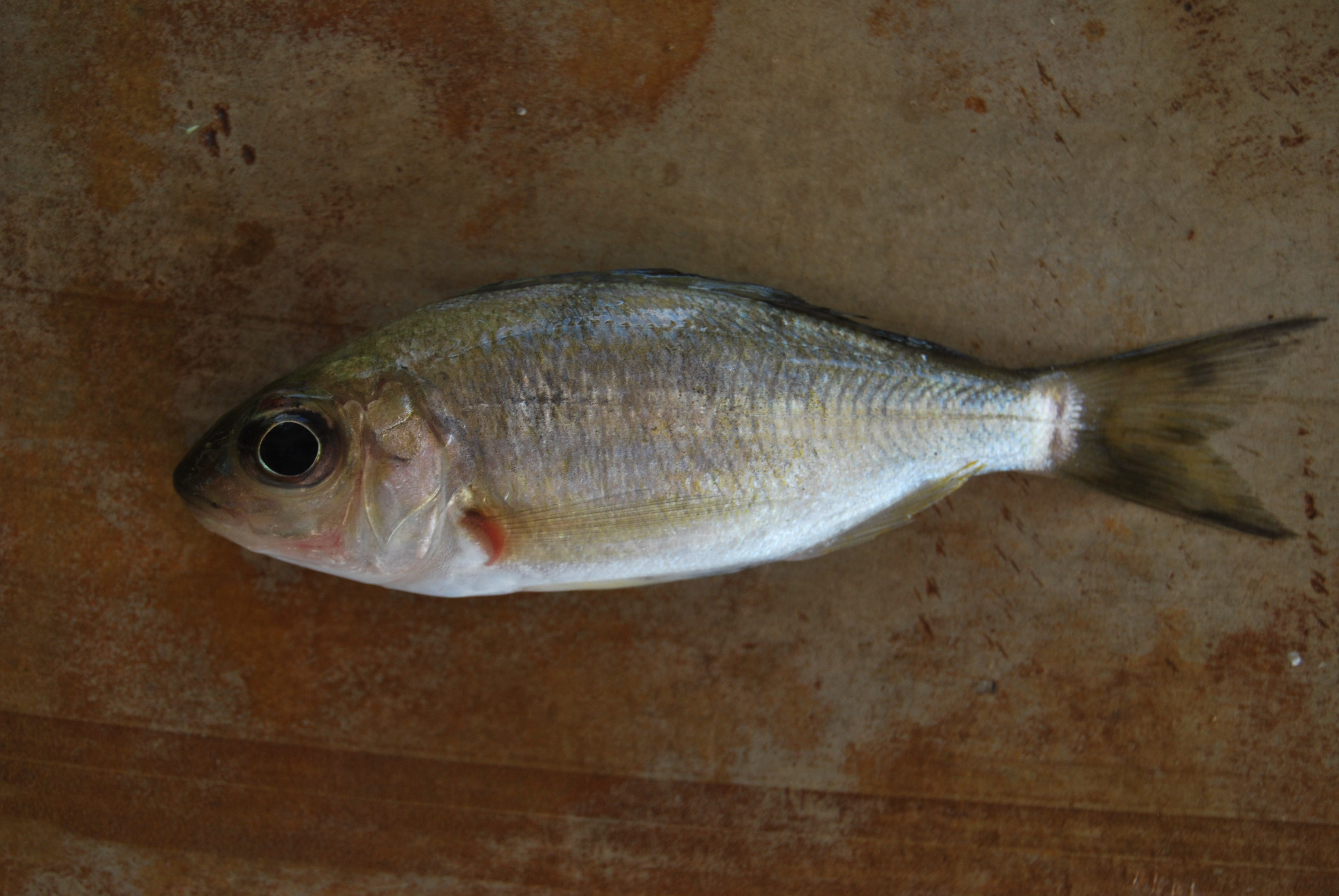
This is a modestly sized cichlid: the largest recorded specimen measured about 4.1 in (10.4 cm) total length, and aquarium fish typically top out around 4 in (10 cm). The body is the streamlined, slightly compressed shape of a fish that spends its life cruising just above sand. Coloration is mostly silver to pale pearly grey, often with a soft metallic or bluish sheen and faint vertical shading, which lets the fish vanish against a sunlit sandy bottom.
The field mark that settles identification is a single conspicuous black spot or blotch on the dorsal fin. In true E. descampsii that spot sits roughly in the middle of the fin; in the lookalike Ectodus sp. "north" it lies further forward, and that northern form also runs a little smaller — a useful pair of cues given how easily the two are confused in the trade. Sexual dimorphism is subtle and not fully documented. Several sources report that the male's dorsal spot is larger and that breeding males develop a higher dorsal fin and somewhat stockier build with intensified color during display, but reliable hard-and-fast sexing characters are thin, and keepers generally read sex from behavior at spawning time rather than from fixed external traits.
Range & habitat
Ectodus descampsii is endemic to Lake Tanganyika and, unlike many of the lake's widespread cichlids, it occupies only the southern sector. Its range runs from the Livua (Moliro) river delta in the Democratic Republic of the Congo, along the entire Zambian shoreline, and up the Tanzanian coast roughly as far as the mouth of the Ifume River near Karema (Verne 2001). The IUCN assessment puts the extent of occurrence at under 11,000 km2 — a genuinely small footprint for a lake fish. Within that band it breaks into the geographic color variants prized by aquarists, named for localities such as Ndole Bay, Sumbu, Kipili, Kala, Chisanze, and the Mvuna, Lupita and Ulwile islands.
The habitat is consistent and easy to picture: very shallow, sunlit, open sand. FishBase records the fish as gregarious over coarse sand bottoms at water temperatures of about 24-26°C (75-79°F), and divers most often meet it in the shallows just off the beach rather than out in deep or rocky terrain. Like the rest of Tanganyika's littoral cichlids it lives in hard, alkaline water; in-lake values cluster around pH 8-9 with high mineral content and oxygen-rich shallows. This tight association with the open sandy shelf is the single most important fact about the species, because it places E. descampsii squarely in the habitat guild most exposed to shoreline disturbance.
Ecology & diet
Functionally, E. descampsii is a sand-sifter, and that role defines almost everything about it. It works the substrate methodically, taking in mouthfuls of sand, sorting the edible fraction with its gill rakers and pharyngeal apparatus and expelling the clean grit. Poll's classic 1956 study of the lake's cichlids found its gut packed with insect larvae and small crustaceans swallowed alongside filamentous algae and a great deal of sand; FishBase summarizes the diet as microorganisms, diatoms and algae. The intestine is short — roughly equal to the body length — which is consistent with an animal-leaning, partly omnivorous diet rather than a dedicated herbivore's long gut. FishBase places it at a trophic level near 2.5, the low-carnivore band typical of invertebrate-and-algae sifters.
In the community it is a small, low-on-the-food-chain forager that converts the meiofauna and detritus of the sand flats into fish biomass, and it shares those flats with other Ectodini sand specialists such as Xenotilapia, Callochromis and Aulonocranus. It is harmless to humans, and its modest size and shoaling habit make it prey for the lake's larger piscivores. The species is gregarious by nature: in the wild it moves in sizable groups, a structure that offers safety on exposed open sand where there is nowhere to hide.
Behavior & breeding
Out of water and out of a tank, the picture is of a nervy, sociable fish. E. descampsii is easily spooked and does poorly around boisterous or aggressive neighbors; security comes from numbers, and individuals kept without a proper shoal tend to grow withdrawn. Among themselves the fish are only mildly territorial, with dominant males claiming and defending small patches of sand.
Breeding is a polygamous, maternal mouthbrooding affair built on the open-sand lifestyle. A dominant male establishes a territory and excavates a shallow pit or depression in the substrate, then displays to passing females with heightened color. After the female lays in the pit and the eggs are fertilized, she takes them into her mouth and broods them — incubation runs on the order of a few weeks before she releases free-swimming fry. As with many open-arena spawners, there is a sneaker dynamic: subdominant males are reported to dart into a spawning pair and attempt to fertilize some of the eggs. It is worth being candid that the fine detail of wild spawning is sparsely documented, and several careful sources note that natural breeding behavior has been little observed; the maternal-mouthbrooder, pit-spawning outline is well supported, but specifics like clutch size and exact brooding duration are not firmly pinned down.
In the aquarium
This is an uncommon fish in the hobby and very much one for the patient Tanganyika specialist, not the beginner. The non-negotiables are a long, open-footprint tank, a deep bed of fine sand for natural sifting, and a calm community. A 36 in (90 cm) tank is a realistic working minimum for a group, with bigger and longer strongly preferred — and a group is essential, because this is a shoaling species that should be kept eight or more strong to behave normally and feel secure. Pair it with peaceful Tanganyikans that occupy other zones: Julidochromis and Neolamprologus among the rocks, open-water Cyprichromis above, and Tanganyikan Synodontis catfish below. The cardinal mistake is housing it with Mbuna or other pushy, fast cichlids, which leaves these shy fish stressed, outcompeted and hiding.
Water should mirror the lake: hard and alkaline, roughly pH 7.5-9.0 and 24-27°C (75-81°F), kept clean and well oxygenated. Diet is easy — it accepts prepared foods readily, and a mix of quality flake or pellet supplemented with frozen or live invertebrates such as brine shrimp keeps it in condition; spreading small feedings out suits its constant grazing habit. The honest caveat is reproduction: spawning in aquaria is rarely reported and considered difficult, so anyone buying these to breed should expect a project, not a sure thing. Reports of a long lifespan circulate in care write-ups but are not well documented and are best treated cautiously.
Conservation
Ectodus descampsii was reassessed on the IUCN Red List in 2025 (assessment by Sibomana, reviewed by Konings) as Vulnerable under criterion B1ab(iii,v), a notable downgrade from its Least Concern listing in 2006. The reasoning is geographic and concrete: a small range (extent of occurrence under 11,000 km2), few threat-defined locations, and a continuing decline in both habitat quality and mature individuals, with the species reported to have nearly disappeared from Zambian shores and to be highly threatened in Tanzania. The population trend is decreasing. The two named threats are over-fishing — chiefly illegal beach-seine netting, which rakes the very shallow sandy habitat this fish depends on — and sedimentation and pollution from soil erosion and agricultural runoff degrading that habitat. The species is taken locally for food and is traded internationally for the aquarium hobby, though collection pressure is secondary to the fishery here.
Those species-level threats sit inside a lake under broad strain. Lake Tanganyika is warming, and that warming stabilizes its stratification and shrinks the mixing that brings nutrients up from the deep: O'Reilly and colleagues (2003) inferred a primary-productivity decline of roughly 20%, implying on the order of a 30% drop in fish yields, while Cohen and colleagues (2016) used paleorecords to link warming to losses of commercially important fish and of oxygenated benthic habitat. Sedimentation from deforested catchments is a long-recognized degrader of the shallow littoral the lake's cichlids occupy. These basin pressures, together with the clupeid (Stolothrissa and Limnothrissa) and Lates pelagic fishery that feeds four nations, are managed — imperfectly — through the four-country Lake Tanganyika Authority. For a shallow open-sand specialist like E. descampsii, the warming-and-productivity story is less directly threatening than it is for offshore species; the sharp end for this fish is the inshore one — beach seines and sediment smothering exactly the sunlit sand flats it cannot live without. The candid summary is that this is no longer a fish to wave off as secure: a once-common shallow endemic, now Vulnerable, in a lake whose pressures fall hardest on the very habitat it occupies.
Sources
- Eschmeyer's Catalog of Fishes — Ectodus descampsii (Boulenger 1898)
- FishBase — Ectodus descampsii summary
- GBIF — Ectodus descampsii Boulenger, 1898
- IUCN Red List — Ectodus descampsii (Sibomana 2025, Vulnerable)
- Koblmüller et al. 2004 — Evolutionary relationships in the sand-dwelling cichlid lineage (Ectodini) of Lake Tanganyika
- Tribe Ectodini overview — Cichlid Room Companion
- Ronco et al. 2019 — The taxonomic diversity of the cichlid fish fauna of ancient Lake Tanganyika
- O'Reilly et al. 2003 — Climate change decreases aquatic ecosystem productivity of Lake Tanganyika (Nature)
- Cohen et al. 2016 — Climate warming reduces fish production and benthic habitat in Lake Tanganyika (PNAS)
- Lake Tanganyika: status, challenges and opportunities for research (J. Great Lakes Research, 2023)
- Seriously Fish — Ectodus descampsii (Descamp's Strange-Tooth Cichlid)
- tanganyika.si — Ectodus descampsii localities and images
- Aqua-Fish.net — Ectodus descampsii care guide
- The Aquarium Wiki — Ectodus descampsii
- Fishipedia — Ectodus descampsii
- Cichlid-Forum — Ectodus descampsii from Lake Tanganyika (species profile thread) — community/anecdotal
- MonsterFishKeepers — Tanganyika sand-cichlid stocking discussion (mentions Ectodus descampsii) — community/anecdotal