
Taxonomy & naming
Max Poll described this fish in 1949 as Limnotilapia loocki, from material the Belgian Hydrobiological Mission to Lake Tanganyika (1946–1947) collected near Kigoma on the lake's eastern shore. The species epithet honors E. Van Loock, then Director of the Great Lakes Railways Company, who backed that expedition; the holotype rests in the Royal Museum for Central Africa (MRAC 106261).
The genus history is the interesting part. Maréchal and Poll (1991) later moved the species into Simochromis, and the older IUCN assessment still listed it under that name. Then Yamaoka, Hori and Kuwamura (1998, South African Journal of Science) erected the new genus Interochromis specifically for it, arguing on combined morphological and ecological grounds that loocki did not belong with the browsing Simochromis at all. Their reasoning is worth stating plainly because it foreshadows everything else about the fish: its intestinal coiling, neurocranium, maxilla, and feeding ecology all resemble the algae-grazing genus Petrochromis far more than they resemble its nominal relatives, while its jaw dentition sits intermediate between grazers and browsers. The name Interochromis nods to that "in-between" position. Catalog of Fishes and FishBase both accept Interochromis loocki as the valid name today.
It remains a monotypic genus and a member of the Tropheini, the tribe of rock-dwelling, mouthbrooding cichlids that includes Tropheus, Petrochromis, and Simochromis. Genome-scale work on the Tanganyikan radiation (Singh and colleagues, 2022) recovers Interochromis loocki nested within a Petrochromis clade, confirming what the hobby trade name "a Petrochromis-like fish (sold under various 'Petrochromis sp.' trade names)" had implied for decades; aquarists also encounter it under collection labels such as "Kasanga" or "Chimba" for the locality of origin.
Appearance
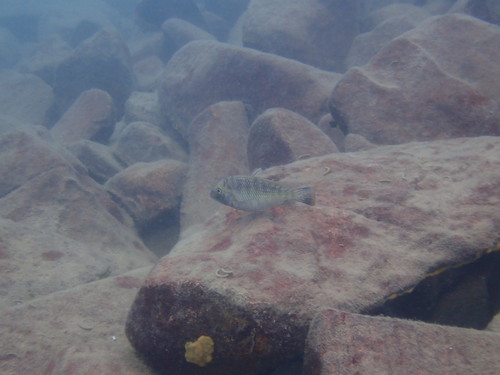
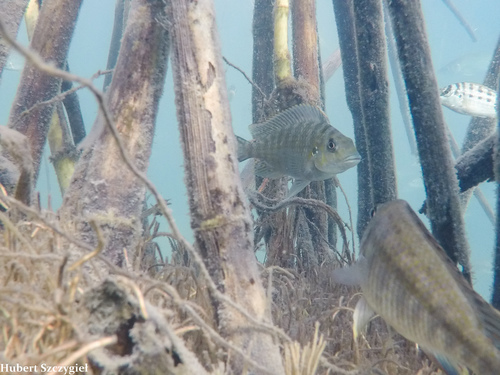
This is a small, compact Tanganyikan, reaching about 4 in (10.5 cm) total length according to FishBase's maximum record — modest by the standards of the larger Petrochromis it resembles. The body is deep and muscular with a blunt, rounded head and the slightly underslung, broad mouth of a fish built to rasp algae off rock.
Coloration is variable and locality-dependent, which is part of why the fish has circulated in the trade under several geographic tags. Live animals are typically olive to brassy on the flanks, sometimes shading to a greenish cast (one research description even refers to a "green" loocki), often with faint vertical barring and a darker dorsal surface that grades to a paler belly. The most reliable way to separate it from true Petrochromis is dentition under close inspection: the outer jaw teeth are enlarged, bicuspid, and bent inward on slender stalks, set clearly apart from the smaller tricuspid inner teeth — a pattern Yamaoka et al. read as intermediate between dedicated grazers and browsers. Sexual dimorphism is modest; as in most Tropheini, dominant males color up most strongly while holding territory, and the sexes are otherwise similar in size and shape.
Range & habitat
Interochromis loocki is a lacustrine endemic, found only in Lake Tanganyika and nowhere else on Earth. Within the lake it is widespread but patchily distributed; the IUCN assessment notes a discontinuous range and records that it does not appear to occur in the Burundi (far northern) waters. FishBase places it across the tropical mid-lake latitudes, roughly 3°S to 9°S.
Its world is the rocky littoral — the boulder- and cobble-strewn slopes that ring much of the lake and host the great majority of Tanganyika's cichlid diversity. It is a demersal fish of the upper rocky zone rather than open water or sand. A 14-year field study of coexisting herbivorous cichlids on a rocky slope (Hata and Ochi, 2016) is unusually informative here: it classed loocki as a territorial grazer and found it occupying an intermediate-to-deeper band of the rocky slope, sitting below shallow-water grazers such as Petrochromis polyodon and P. famula and alongside P. trewavasae and P. horii in successively deeper zones. That fine-scale depth partitioning is how a dozen-plus algae-eaters share the same wall of rock without starving each other out. Lake Tanganyika's surface waters are warm (roughly 75–81°F / 24–27°C), hard, alkaline, and highly stable, with a pH around 8.6–9.2 — the chemistry any keeper has to reproduce.
Ecology & diet
Functionally, loocki is a Petrochromis in everything but name. It is an epilithic algal grazer: it feeds by rasping the "aufwuchs," the dense felt of attached algae, diatoms, and associated micro-invertebrates that coats sunlit rock surfaces, and it concentrates on unicellular algae rather than tearing at filamentous strands the way browsers do. FishBase summarizes its diet as feeding on debris and assigns it a low trophic level of about 2.0, consistent with a near-pure herbivore. Its long, Petrochromis-type coiled intestine is the gut of an animal processing large volumes of low-energy plant matter.
In the community, it occupies the grazer guild of the rocky littoral — one node in a remarkably crowded niche space where multiple superficially equivalent algae-eaters coexist by carving up depth, substratum angle, and feeding-territory behavior. The territoriality is itself ecological: by defending a patch of rock, a dominant male loocki effectively "farms" and regrows its algal lawn, the same strategy that makes territorial Tropheini such persistent fixtures of the reef.
Behavior & breeding
Interochromis loocki is a maternal mouthbrooder, like the rest of the Tropheini. Yamaoka and colleagues flagged it as incubating relatively large eggs, again in the Petrochromis mold. After a male fertilizes the clutch, the female takes the eggs into her mouth and broods the developing young there through hatching, releasing free-swimming fry only once they can fend for themselves — a low-fecundity, high-investment strategy that trades egg number for survival.
Socially it is territorial rather than pair-bonding. The field literature describes feeding territories held by dominant males only; subordinate fish and females range more loosely. That maps onto the hobbyist experience: this is a pugnacious, space-conscious fish. Keepers and importers consistently describe it as aggressive and best housed in a species setup or with robust, fast tankmates — the same temperament that earns true Petrochromis their reputation. Spawning in captivity follows the standard Tropheini pattern, with a colored-up male displaying over his territory and a receptive female spawning and then carrying.
In the aquarium
This is not a beginner's fish, and it is not a community fish in the gentle sense. loocki carries the full Petrochromis-style package: high activity, real intraspecific aggression, and a herbivore's gut that punishes the wrong diet. Give it length to disperse aggression — a four-foot tank is a sensible practical floor for a small group, and more is better; some keepers report success with single specimens or odd numbers in mid-size tanks (community posts mention setups in the ~60-gallon / 230-liter range), but crowding sharpens the fighting rather than diffusing it. A rockwork-heavy aquascape with clear sightline breaks lets subordinates escape a dominant male.
Water must match the lake: hard, alkaline (pH roughly 8.0–9.0), well-oxygenated, and warm (about 77–81°F / 25–27°C), with low nitrate and strong filtration to handle a vigorous grazer's output. Diet is the make-or-break detail. As an algae specialist it needs a high-fiber, vegetable-based regimen — spirulina and similar dried foods, ideally over grazeable surfaces — and should not be fed protein-rich, meaty foods, which in herbivorous Tanganyikans are linked to the digestive disorder hobbyists call "bloat." The common mistakes are predictable: treating it as just another mbuna-style rock cichlid, underestimating its aggression, and overfeeding protein. Sourcing can also frustrate, since it still moves through the trade under the a Petrochromis-like fish (sold under various 'Petrochromis sp.' trade names) label and various locality names.
Conservation
The IUCN Red List assesses Interochromis loocki as Least Concern, most recently on 14 March 2025 (a reassessment of an earlier 2006 Least Concern listing made under the name Simochromis loocki). The justification is straightforward: it is a widespread species across Lake Tanganyika, and while some threats exist, they are not considered severe enough to push it toward a threatened category. Its population trend is listed as unknown, and there is no evidence of targeted collection pressure heavy enough to dent it — the aquarium trade takes it, but not at species-threatening volume.
That clean status sits inside a lake that is itself under measurable strain, and an honest account has to hold both facts at once. Lake Tanganyika is warming: O'Reilly and colleagues (2003, Nature) showed that rising temperatures have strengthened stratification and reduced the deep mixing that fertilizes surface waters, cutting primary productivity with knock-on declines in fish yields. Cohen and colleagues (2016, PNAS) used sediment cores to document warming-driven loss of oxygenated benthic habitat and concurrent declines in commercially important fishes and endemic molluscs over the past century. For a rocky-shore grazer like loocki, though, the more directly relevant threat is sedimentation: deforestation and erosion along the lake's catchment smother the rocky littoral in silt, and that habitat degradation is recognized as the principal pressure on Tanganyika's rock-dwelling cichlid communities (Cohen et al. 1993; Alin et al. 1999). Roughly two-thirds of the lake's endemic cichlids are tied to rocky habitat, so siltation of the shoreline is a community-wide concern, not just one species' problem. Governance is shared by the four riparian nations — Burundi, the Democratic Republic of the Congo, Tanzania, and Zambia — under the Lake Tanganyika Authority. So the truthful framing is this: I. loocki itself is not currently at risk, but it depends entirely on the shallow rocky biotope that the lake's wider pressures are slowly eroding.
Sources
- Interochromis loocki — FishBase summary
- Eschmeyer's Catalog of Fishes — Limnotilapia loocki / Interochromis loocki
- Interochromis loocki — IUCN Red List (assessed 2025)
- Yamaoka, Hori & Kuwamura (1998), Interochromis, a new genus of the Tanganyikan cichlid fish (abstract, CRC)
- Hata & Ochi (2016), Depth and substratum differentiations among coexisting herbivorous cichlids in Lake Tanganyika, R. Soc. Open Sci.
- Phylogenomics of trophically diverse cichlids (Singh et al. 2022), Ecol. Evol. — loocki in Petrochromis Clade II
- Interochromis loocki species profile — Cichlid Room Companion
- O'Reilly et al. (2003), Climate change decreases aquatic ecosystem productivity of Lake Tanganyika, Nature (PDF)
- Cohen et al. (2016), Climate warming reduces fish production and benthic habitat in Lake Tanganyika, PNAS
- Alin et al. (1999), Effects of landscape disturbance on animal communities in Lake Tanganyika, Conservation Biology
- Cohen et al. (1993), Impact of sediment pollution on biodiversity in Lake Tanganyika (JSTOR)
- Spatial variability in nearshore sediment pollution in Lake Tanganyika
- Interspecific relationships of aufwuchs-eating fishes in Lake Tanganyika (ResearchGate)
- Lake Tanganyika fisheries declining from global warming (UKNow summary of Cohen et al. 2016)
- Interochromis loocki keeping notes — Cichlid Room community post (anecdotal) — community/anecdotal
- Importer/keeper notes on Petrochromis-like Interochromis loocki aggression (anecdotal) — community/anecdotal