Taxonomy & naming
Labeotropheus fuelleborni was described by the German ichthyologist Ernst Ahl in 1926, from material collected near Langenburg (modern Lumbila, Tanzania) at the northern end of Lake Malawi; the lectotype (ZMB 22707) sits in the Berlin zoological museum. Eschmeyer's Catalog of Fishes lists it as a valid name, Labeotropheus fuelleborni Ahl 1926 — note that some hobby and even older scientific sources render the year as 1927, but 1926 is the authority date Eschmeyer carries. The genus name blends Latin labeo, "one with large lips," with a Greek root for trophy, a nod to the conspicuous specialized teeth; the species honors Friedrich Fülleborn, a German physician and parasitologist.
The fish belongs to the mbuna — the rock-dwelling, algae-grazing radiation of haplochromine cichlids that, with the deeper-water haplochromines and the sand-dwellers, makes up Lake Malawi's celebrated species flock. Labeotropheus is a small genus defined by that overhanging snout and inferior mouth. For most of the twentieth century it held just two species: the robust-bodied L. fuelleborni and the slimmer L. trewavasae (Fryer, 1956). That has changed sharply: Michael Pauers and colleagues elevated a string of former geographic races to full species, beginning with L. artatorostris in 2017 and continuing with six more — including L. alticodia, L. candipygia, and L. obscurus, all carved out of what was once broadly called L. fuelleborni — in 2023. Many populations that aquarists still buy and sell as "fuelleborni" variants therefore now carry, or may eventually carry, their own names.
Appearance
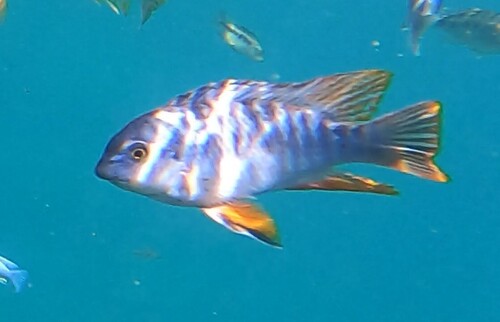
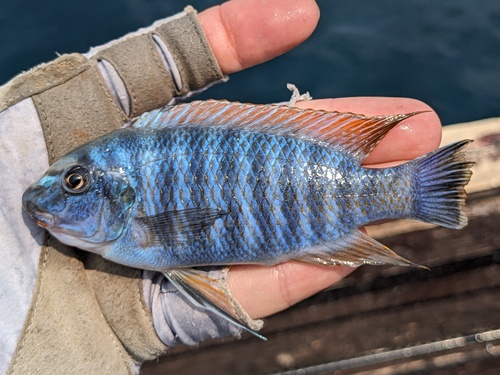
The defining feature is the snout: a pad of fibrous connective tissue that projects forward and down over a broad, ventrally placed mouth, giving the fish an almost beak-like profile unlike any other Malawi cichlid except its congeners. Inside that mouth sit rows of close-set, curved, chisel-tipped teeth. The body is stocky and deep — the "robust" half of the genus, contrasting with the slender L. trewavasae.
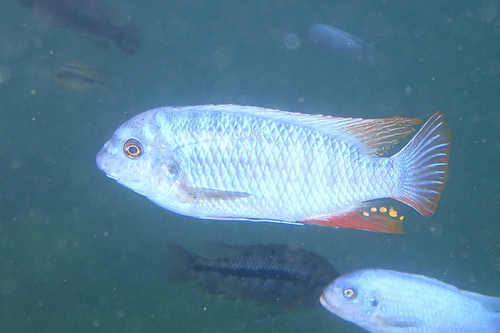
Color is where this fish earns its reputation. Mature males turn a brilliant blue, often with golden-yellow on the flanks and a row of two to four orange "egg-dummy" ocelli along the anal fin. Females are dramatically polymorphic: a normal (N) morph of dull blue-grey, paler below and crossed by up to eight darker vertical bars, coexists in the same populations with an orange-blotch (OB) morph mottled in black, orange, and white, and some OB females are nearly solid yellow. Because color pattern varies sharply from one island or reef to the next, populations are traded under a parade of location and color names — "Marmalade Cat," "Katale," "Chilumba," and so on. Those same population differences are now driving the genus's taxonomic split, so a striking color form is sometimes the first sign of an undescribed or newly described species rather than a mere variant.
Reported maximum size needs a caveat. FishBase lists 30 cm (about 12 in) standard length, but that figure is widely regarded as an outlier or error; field and aquarium sources consistently put adults closer to about 12 cm (4.7 in) total length, with females a touch smaller than males. Treat the larger number with skepticism and plan around a 4-to-5-inch fish.
Range & habitat
Labeotropheus fuelleborni is endemic to Lake Malawi (also called Lake Niassa or Nyasa), where Eschmeyer and FishBase record it as widely distributed, including around offshore islands. As taxonomists split the genus, the strict range of "true" L. fuelleborni is narrowing toward its northern type locality, but the broad fuelleborni-type form occurs along rocky coasts throughout much of the lake.
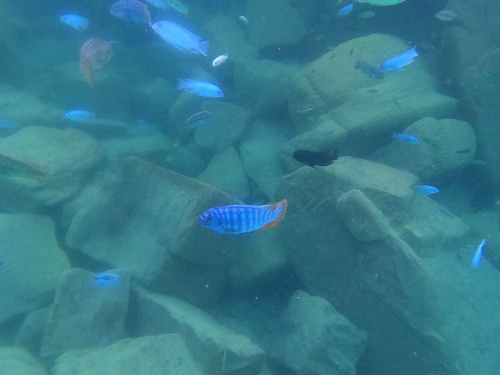
This is an obligate inhabitant of the rocky littoral. Surveys place it in shallow water, typically 1–5 m (roughly 3–16 ft) and rarely deeper than about 8 m (26 ft); FishBase gives a depth band of 1–6 m. It lives where wave-washed rock meets clear, well-oxygenated water — the brightly lit zone where the algal turf it depends on grows thickest. The lake's water is hard and alkaline, with FishBase citing a pH near 7.5–8.5 and surface temperatures around 22–25 °C (72–77 °F). Because the fish is welded to this narrow rocky-shore band, it does not cross the stretches of open sand that separate rocky habitats, which is exactly why populations on different reefs and islands have diverged in color so freely.
Ecology & diet
Functionally, L. fuelleborni is an aufwuchs scraper — aufwuchs being the felt of filamentous algae, diatoms, microbes, and trapped detritus that coats sunlit rocks. The whole head is engineered for the job: the down-pointed mouth lets the fish hold its body nearly parallel to the rock face and rake the surface with its chisel teeth, a feeding posture and dental morphology that have made Labeotropheus a model system for studies of cichlid trophic specialization. Comparative work (e.g., Kassam and colleagues) ties its short, deep neurocranium and steeply angled jaw to this scraping, biting style, as opposed to the combing, nipping action of finer-toothed algae-pickers.
In practice the diet is broader than "algae." The fish takes the loose epilithic algae and, with it, the small invertebrates living in the turf — and gut and field studies record worms, crustaceans, insect larvae, plankton, and even fish eggs and fry consumed opportunistically. FishBase places it at a trophic level around 2.8, consistent with a herbivore-leaning omnivore rather than a strict plant-eater. Most individuals feed alone or in small mixed groups over their patch of rock, but Marsh and Ribbink documented a striking exception: members occasionally band into feeding schools of hundreds that swamp and overwhelm the defended algal gardens of other, more territorial mbuna — a numbers-game raid that lets the scrapers feed in places they could not hold one-on-one.
Behavior & breeding
Like the rest of the mbuna, L. fuelleborni is territorial over rock and the algae growing on it, and males in particular defend space against their own kind. It is a maternal mouthbrooder: after a male courts a female over his territory and fertilizes the eggs — the orange spots on his anal fin are thought to play into the spawning ritual, drawing the female to mouth at them as she collects the clutch — she takes the eggs into her mouth and broods them there. Reports of brooding duration run to roughly three to four weeks (about 22–30 days), after which she releases free-swimming fry that scatter into rock crevices to escape predators. Females do not feed while brooding and emerge visibly thinner.
The genus's color polymorphism is wrapped up in its breeding biology. Pauers' work on mate choice in L. fuelleborni found that visually based male and female preferences track population color differences in a way consistent with reproductive isolation — in other words, the riot of island-by-island color is not just decoration but part of how these fish recognize and choose mates, a plausible engine for the rapid speciation now being formalized in the taxonomy.
In the aquarium
Blue mbuna are a staple of the African-cichlid hobby and are not difficult to keep alive, but they are not a community fish and not a beginner's centerpiece. They want a hard, alkaline rift-lake setup — high pH, plenty of stacked rock for territories and hiding, and the strong filtration and routine water changes mbuna tanks demand. Diet should lean herbivorous: a quality spirulina- or vegetable-based cichlid pellet suits their grazing gut, and keepers caution against heavy protein or live-food regimes, which mbuna tolerate poorly over time.
Aggression is the real management problem. Experienced keepers describe them as more aggressive than gentler mbuna like yellow labs or rusties, though "not killers" — the standard advice on cichlid forums is to keep one male with a harem of several females (1:4, often pushed to 1:7) to spread out a dominant male's harassment, and to overstock modestly with broken sightlines so no single fish monopolizes the tank. A 4-foot, roughly 75-gallon (about 285 L) tank is a sensible practical minimum for a colony; smaller setups concentrate aggression. Conspecific males are the main flashpoint, so all-male display tanks or single-male harems are the usual routes. The common hobbyist mistake is treating them as peaceful algae-eaters and mixing them with timid species or too few females — both reliably end badly. They are also easy to hybridize with the closely related L. trewavasae and with other mbuna, so serious keepers house them by species and source from reputable lines.
Conservation
The IUCN Red List assessed Labeotropheus fuelleborni as Least Concern (assessment dated 22 June 2018). It is a widely distributed, locally common rock-dweller with no evidence of broad decline, and while it is collected for the aquarium trade and turns up in artisanal catches, neither is currently judged a population-level threat. One footnote: the species has been recorded as a non-native aquarium escapee in Florida, where a small population was eradicated in 2017 — a reminder to never release tank fish, not a sign of trouble in its native range. The ongoing taxonomic splitting does carry a quiet caveat, though: as former "fuelleborni" populations are recognized as distinct, narrow-range species, some of those newly minted taxa will have far smaller distributions than the broad species and warrant their own, more cautious assessments.
That "Least Concern" rating sits inside a lake that is itself under real strain. The basin review by Chavula and colleagues (Journal of Great Lakes Research, 2023, 49(6):102241) catalogs the pressures: over-fishing that has driven the collapse of the commercially vital chambo (Oreochromis) fishery; sediment and nutrient loading washing off deforested, eroding catchments; and a warming of roughly 0.7 °C in the shallow water column that strengthens stratification, slows the mixing that lifts nutrients from the depths, and ultimately trims the lake's productivity. For a shallow rocky-shore grazer like L. fuelleborni, the most direct threat is sedimentation: silt smothers the rock surfaces and dims the light its algal turf needs, degrading exactly the narrow, sunlit habitat band the fish cannot leave. The honest summary is that the species itself is not endangered, but the rocky littoral it depends on is exposed to the same shoreline development, runoff, and climate pressures squeezing the whole lake — so its status is best read as secure for now, contingent on the catchment.
Sources
- Eschmeyer's Catalog of Fishes — Labeotropheus fuelleborni
- FishBase — Labeotropheus fuelleborni (Blue mbuna)
- FishBase — Reproduction summary, Labeotropheus fuelleborni
- USGS NAS — Blue mbuna (Labeotropheus fuelleborni) species profile
- Cichlid Room Companion — Labeotropheus fuelleborni profile & taxonomy news (Konings/Artigas Azas)
- Ribbink, Marsh, Marsh & Sharp (1983) — Zoogeography, ecology and taxonomy of Labeotropheus, Zool. J. Linn. Soc. 79:223-243 (via USGS NAS)
- Kassam et al. (2004) — Functional significance of variation in trophic morphology within algae feeders (PDF)
- Pauers (2011) — One Fish, Two Fish, Red Fish, Blue Fish: geography, ecology, sympatry and male coloration in Labeotropheus, Int. J. Evol. Biol.
- Pauers — Female and male visually based mate preferences and reproductive isolation in Labeotropheus fuelleborni (ResearchGate)
- Pauers & Phiri (2023) — Six new species of Labeotropheus, Ichthyology & Herpetology 111(2):264-292 (summary via CRC)
- Microcomputed tomography linking head morphology and feeding in Lake Malawi aufwuchs-feeders (PMC)
- Chavula et al. (2023) — Lake Malawi/Niassa/Nyasa basin: Status, challenges, and research needs, J. Great Lakes Res. 49(6):102241
- IUCN Red List — Labeotropheus fuelleborni (Least Concern, assessed 2018)
- USFWS — Ecological Risk Screening Summary: Blue Mbuna (Labeotropheus fuelleborni) (PDF)
- Cichlid Fish Forum — Labeotropheus fuelleborni compatibility (keeper discussion) — community/anecdotal
- FishProfiles.com forum — Mbuna helpful hints (keeper notes on L. fuelleborni aggression) — community/anecdotal
- r/AfricanCichlids — managing aggression in Malawi mbuna tanks (community) — community/anecdotal