Taxonomy & naming
Paracyprichromis brieni was described by the Belgian ichthyologist Max Poll in 1981, originally as Cyprichromis brieni. Poll later erected the genus Paracyprichromis in 1986 to hold this fish and its relative P. nigripinnis, separating them from the true Cyprichromis on the basis of skeletal differences and a different mode of fertilization. Catalog of Fishes and FishBase both treat the valid combination as Paracyprichromis brieni (Poll, 1981), with Cyprichromis brieni listed as a synonym. The species name honors Paul Louis Philippe Brien (1894–1975), a Belgian zoologist; the genus name stacks Greek roots (para-, "beside," plus the Cyprichromis it sits next to).
The genus is part of the tribe Cyprichromini, a tight cluster of zooplanktivorous, water-column cichlids. Mitochondrial DNA work has confirmed that the two Paracyprichromis species are each other's closest relatives but are not nested inside Cyprichromis, supporting Poll's split. Taxonomy below the species level is unsettled: P. brieni is traditionally treated as one of only two lake-wide species in the genus, yet several geographically distinct populations now lumped under brieni differ enough that some may eventually be described as separate species. One example, found in southern Tanzania around 2008 and carrying both the vertical bars of brieni and horizontal blue flank stripes recalling nigripinnis, circulates as Paracyprichromis sp. 'brieni two-stripe.'
Appearance
This is a small, elongate cichlid, reaching about 4.3 in (11 cm) total length, though most fish seen in the wild and the trade are nearer 4 in (10 cm). The body is slender and pencil-like, built for hovering and short darts rather than sustained open-water cruising. Mature males develop the genus's signature iridescence — rows of reflective neon-blue spangling along the flanks and into the unpaired fins — which flares during courtship; females are plainer.
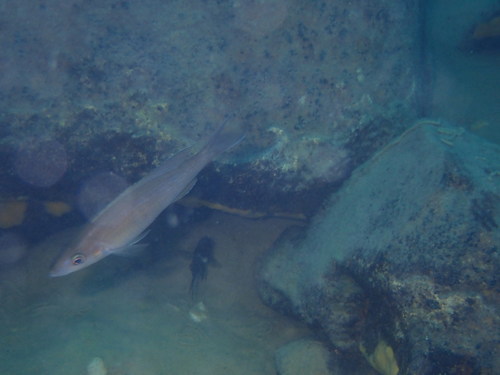
The identification problem in this genus is telling brieni from its sympatric sibling, P. nigripinnis. The two routinely share the same rocks, so keepers and divers lean on body shape and eye size: brieni is the longer, slimmer fish with notably smaller eyes, while nigripinnis is deeper-bodied, more compact, and large-eyed. Color also varies geographically within brieni. The IUCN assessment notes two female morphs distinguished by the anal fin — one with a yellow anal fin (populations at the lake's northern end and the southern part of the west coast) and one with a black-margined anal fin (the central west coast and the central and southern east coast).
Range & habitat
Paracyprichromis brieni is endemic to Lake Tanganyika and occurs essentially lake-wide, with confirmed presence in all four riparian nations — Burundi, the Democratic Republic of the Congo, Tanzania, and Zambia. The type locality is the Ubwari Peninsula on the Congolese coast. Numerous geographically separated populations are recognized, each tied to a stretch of rocky shore.
The fish is a deep rocky-habitat specialist. It lives close to the rock face along the lake's precipitous littoral, and depth records run from just a few meters down to roughly 30–40 m (about 100–130 ft); the related nigripinnis is generally reported deeper, often below 25 m. Territorial males hold station against vertical rock walls rather than retreating into caves, while non-territorial fish feed out in the open water column but never stray far from cover. Tanganyika's chemistry shapes the husbandry: it is a hard, alkaline rift lake, and FishBase summarizes the species' envelope as pH roughly 7.0–8.5, moderate hardness (around 10–15 dH), and tropical temperatures of about 73–82°F (23–28°C). Because it lives in the lake's clear, oxygen-rich upper rocky zone, this is a fish of the well-lit shoreline rather than the deep anoxic basin.
Ecology & diet
Brieni is a zooplanktivore — a water-column feeder that strains drifting zooplankton and small crustaceans from the open water above and beside the rocks. FishBase places it at a trophic level of about 3.4, consistent with a small carnivore taking copepods, cladocerans, and similar prey rather than algae or larger animals. This feeding guild is the defining feature of the Cyprichromini: where most Tanganyikan cichlids graze rock biofilm, sift sand, or ambush prey on the bottom, Paracyprichromis and Cyprichromis exploit the productive but contested mid-water layer just off the reef.
Ecologically the species is gregarious in the extreme, forming schools that FishBase and the IUCN describe as numbering several hundred individuals. Aggregating in open water is a trade-off: it buys efficient access to drifting plankton and some safety in numbers, but it exposes the fish to Tanganyika's pelagic and rock-edge predators, including the lake's piscivorous cichlids and the Lates perches that hunt the open water. The schools' tight association with vertical rock means a quick retreat to cover is always close at hand.
Behavior & breeding
Like all Tanganyikan cichlids in its lineage, P. brieni is a maternal mouthbrooder, but its spawning mechanics are unusual enough that they have drawn formal study. Hidehiko Ochi's 1996 work in Ichthyological Research compared the mating systems of two midwater spawners — Cyprichromis microlepidotus and Paracyprichromis brieni — and described how brieni males set up courtship territories in the water column near vertical rock surfaces and lead approaching females down to the rock to spawn. The act is fast and head-down: the female drops one relatively large egg at a time, the male releases milt immediately in front of the falling egg, and the egg is fertilized against the rock before the female turns and takes it into her mouth. This external fertilization is the key behavioral break from Cyprichromis, where fertilization happens away from the substrate.
Clutches are small — typically about 8–15 eggs, with a maximum near 25 — and the female broods the eggs and larvae for roughly three weeks before releasing free-swimming fry that immediately fold into schools of similarly sized juveniles. Because males display in a fixed spot near the rock, their courtship attracts sneakers: a review of Tanganyikan mating systems (Sefc and colleagues) notes that sneaking attempts were observed in brieni — but not in the off-substrate spawner C. microlepidotus — probably because the rocky setting gives sneaker males nearby refuge, and this can lead to multiple paternity within a brood. Outside of spawning the fish is peaceable, with aggression largely limited to males jostling over rock-face territories.
In the aquarium
Paracyprichromis brieni is a rewarding but genuinely demanding Tanganyikan, not a beginner fish. It occupies the upper and middle water column that most rift-lake cichlids ignore, so it can fill a visual gap — but only if its temperament is respected. Experienced keepers are consistent on the core point: this is a shy, sensitive, easily intimidated species that must be kept in a group. Reports converge on a minimum of about eight to ten fish; smaller groups tend to hide and fade. A tank with a long footprint and real swimming length is important — community-forum consensus is skeptical of anything under a 4-ft (48-in) tank for a serious group, and hobby references suggest a minimum on the order of 65 gal (250 L) and up.
Tankmate selection is where keepers most often go wrong. Active or aggressive cichlids reliably bully brieni into stress and hiding, so the safest setups are species-only or pair it only with calm, bottom-oriented Tanganyikans — Julidochromis, Chalinochromis, or the shell- and rock-dwelling Altolamprologus and Lamprologus — that leave the upper water column alone. One recurring caution from the forums is not to mix brieni with its look-alike P. nigripinnis: they are similar enough to interbreed and to muddy both species in the hobby. Water should mirror the lake — hard, alkaline (pH around 8), warm (mid-70s°F), and very clean, since these open-water feeders are sensitive to poor conditions. Feeding rewards a little observation: brieni take food best while it drifts in the water column and tend to ignore anything that reaches the substrate, so floating or slow-sinking foods (good flake, small pellets, frozen brine shrimp or Cyclops) work better than fast-sinking pellets. Much of the stock in the trade is now tank-bred, which both eases acclimation and reduces pressure on wild populations.
Conservation
The IUCN Red List assesses Paracyprichromis brieni as Least Concern, in an assessment by L. Haambiya last evaluated on 14 March 2025 (it was also Least Concern in the prior 2006 assessment). The rationale is straightforward: the species is endemic to Lake Tanganyika but occurs all the way around the lake, and there are no known major widespread threats, even though its population size and trend are formally unknown. The assessment does flag species-specific pressures: it is an ornamental fish targeted for the aquarium trade, and collection could be a local threat in some areas; on top of that it shares the lake-wide hazards of bycatch from illegal, non-selective fishing gear and shoreline sedimentation. So the honest summary is that the fish itself is not currently in trouble, but the water body around it is under real strain.
That basin-level strain is well documented. O'Reilly and colleagues (2003, Nature, DOI 10.1038/nature01833) showed that climate warming has reduced vertical mixing in Lake Tanganyika, cutting primary productivity by roughly 20% and, by their estimate, lowering potential fish yields by around 30%. Cohen and colleagues (2016, PNAS, DOI 10.1073/pnas.1603237113) added a sobering benthic dimension: paleoecological records indicate warming has shrunk the oxygenated bottom habitat by about 38% in their study areas, with declines in commercial fishes and endemic molluscs tracking the warming. Layered on top are sedimentation and nutrient runoff degrading the rocky littoral (Cohen et al. 1993) and a heavily exploited pelagic fishery — the clupeids Stolothrissa and Limnothrissa together with the Lates perches — that feeds the four bordering countries. Governance is shared through the four-nation Lake Tanganyika Authority, which has trialed a May–August seasonal fishing closure that the IUCN notes would benefit this species by protecting its breeding window. For brieni specifically, the most relevant threads are its tie to the rocky littoral — exactly the zone most exposed to sedimentation and shoreline development — and the fact that it lives in the warming, increasingly stratified upper water layer whose productivity these studies show is in decline. None of that yet adds up to a documented population drop in this particular fish, but it is the context in which a still-common species could quietly lose ground.
Sources
- FishBase: Paracyprichromis brieni summary
- Eschmeyer's Catalog of Fishes (species record, Paracyprichromis brieni)
- IUCN Red List: Paracyprichromis brieni (Haambiya 2025, e.T60643A47205156)
- Ochi (1996) Mating systems of two midwater-spawning cichlids, Cyprichromis microlepidotus and Paracyprichromis brieni, in Lake Tanganyika — Ichthyological Research 43(3):239–246
- Sefc et al. — Mating and Parental Care in Lake Tanganyika's Cichlids (review, PMC3142683)
- O'Reilly et al. (2003) Climate change decreases aquatic ecosystem productivity of Lake Tanganyika — Nature
- Cohen et al. (2016) Climate warming reduces fish production and benthic habitat in Lake Tanganyika — PNAS
- tanganyika.si — Paracyprichromis brieni 'Nkondwe Island' (biotope, depth, breeding)
- tanganyika.si — Paracyprichromis nigripinnis (genus history & comparison)
- AMAZONAS Magazine — Paracyprichromis nigripinnis: A Thing of Beauty (Sumer Tiwari, keeping & breeding notes)
- Cichlid-Forum — Paracyprichromis brieni from Lake Tanganyika (species profile / community) — community/anecdotal
- Cichlid-Forum — How do paracyprichromis deal with haplo-like fish? (tank-size & temperament thread) — community/anecdotal
- Cichlid-Forum — Getting into Tanganyika (habitat & depth discussion) — community/anecdotal
- Reddit r/Cichlid — Tanganyikan stocking suggestions including Paracyprichromis brieni — community/anecdotal